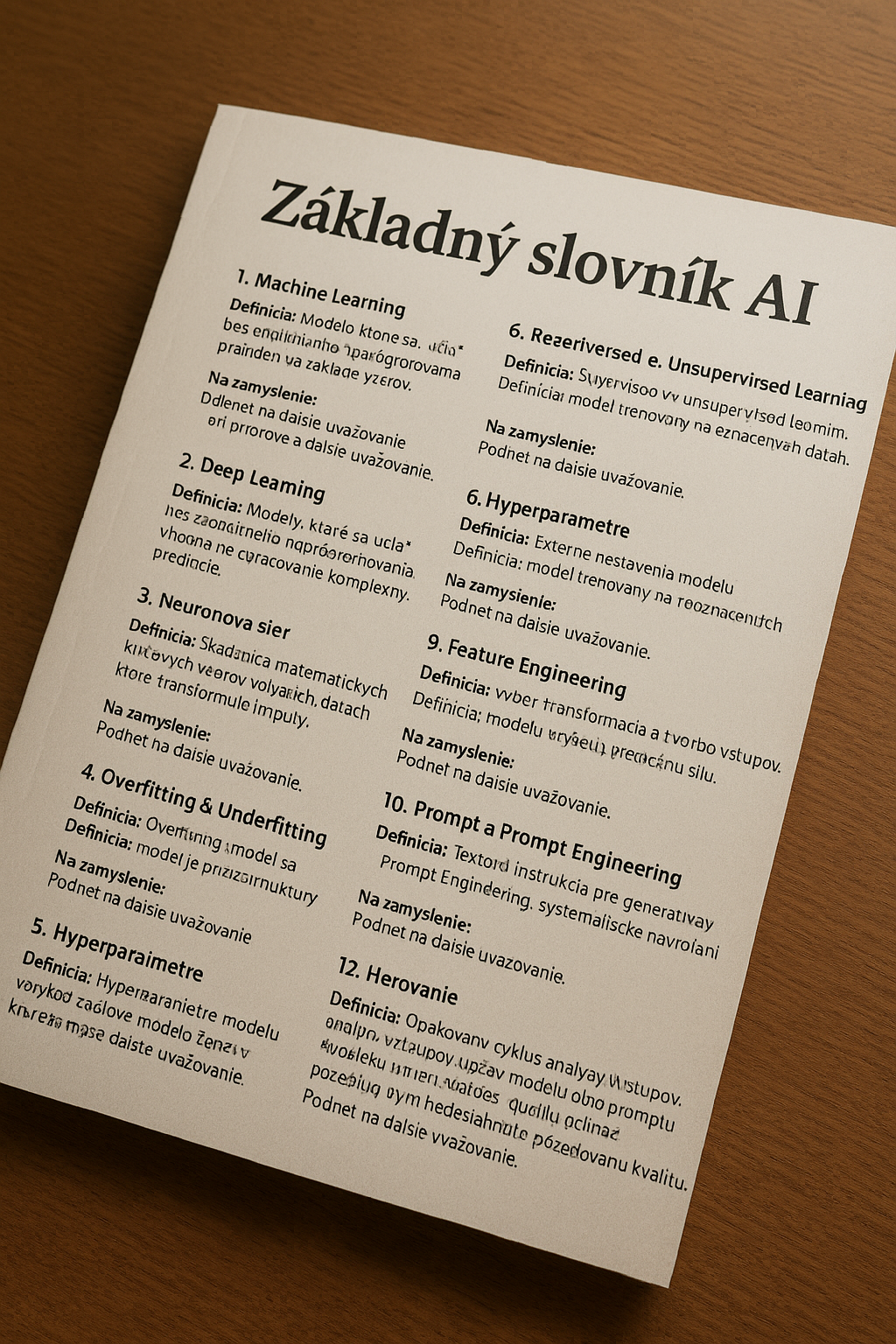
This basic AI glossary offers an overview of key artificial intelligence (AI) terms, prepared by Intermarketing. It focuses on connecting business and marketing through AI – from machine learning to neural networks to prompt engineering and iteration. It is also suitable as a gateway to the world of AI for beginners.
For each term, you’ll find a short definition, a question to ponder, and a thought-provoking reflection to really get to grips with AI concepts and their practical implications.
1. Machine Learning
Definition: models that “learn” from data without explicitly programming rules and make predictions based on patterns.
Food for thought. Do I have enough volume and quality of historical data in my organization to make the investment in ML worthwhile?
Food for further thought: investigate the periodicity of key patterns in your data (quarterly, semi-annually) to set up a pilot.
What is machine learning? – one of the fundamental concepts of AI that everyone considering implementing AI into processes should be familiar with.
2. Deep Learning
Definition: a subset of ML with multi-layer neural networks, suitable for processing complex data (images, audio, text).
Food for thought: do you have hundreds of thousands of records to justify the increased computational demands?
Suggestion for further thinking: test a lighter model first (e.g. Random Forest), then deep learning.
Neural network – what is it? Its deeper layers are the basis of deep learning techniques used in images, text and audio data.
3. Neural Network
Definition: A stack of mathematical “neurons” in layers that transform inputs via weighted sums and activation functions.
Food for thought: do you understand what each layer does (input, hidden, output)?
Food for further thought: look at activation heatmaps to visualize strong patterns.
This term is key in any AI dictionary – it helps to understand how “thinking” models work.
4. Supervised vs. Unsupervised Learning
Definitions:
- Supervised: model trained on labeled data.
- Unsupervised: the model reveals structures in the unlabeled data.
Food for thought: which approach solves your problem better and do you have the resources to do it?
Suggestion for further thinking: combine the two: first segment (unsupervised), then classify (supervised).
A basic pair of AI terms, often searched for in the phrase “AI for beginners”.
5. Reinforcement Learning
Definition: An agent learns through rewards and punishments by interacting with the environment.
Food for thought: Do you have a well-defined KPI as a reward for the agent?
Suggestion for further thinking: create a simple simulated environment for rapid testing.
A perfect example of how artificial intelligence learns to make decisions autonomously – also common in games and robotics.
6. Overfitting & Underfitting
Definitions:
- Overfitting: model adapts to noise, generalizes poorly.
- Underfitting: the model is too simple, it doesn’t even reveal the underlying patterns.
Food for thought: what’s the difference between training and validation error in your reports?
Food for further thought: hang k-fold cross-validation and follow the learning curves.
Terms essential in model training – among the most common terms in AI terminology.
7. Hyperparameters
Definition: external model settings (learning rate, number of layers) that you tune outside the training process.
Food for thought: do you use grid search, random search or Bayesian methods to find them?
Food for thought: try Optuna or Hyperopt libraries for automated search.
A keyword in AI model optimization – often searched for as “AI model setup”.
8. Feature Engineering
Definition: Selecting, transforming, and creating inputs that add predictive power to models.
Food for thought: what new variables would enrich your dataset (time windows, aggregated metrics)?
Food for further thought: use Featuretools to automate feature generation and compare the results.
It is one of the most important steps in building powerful AI models.
9. Model Drift
Definition: decrease in model accuracy after deployment due to changes in data/environment.
Food for thought: do you have alerts set up when metrics drop (e.g. accuracy below a threshold)?
Food for further thought: design a dashboard with performance tracking and thresholds for retraining.
An important concept in long-term AI deployment – maintaining model performance over time.
10. Explainability (XAI)
Definition: the ability of a model (or complementary tools) to explain decision making, often using SHAP or LIME.
Food for thought: can you prepare a document for a regulator that explains the impact of inputs?
Food for further thought: do a SHAP analysis and visualize the top inputs for the key cases.
AI explainability is increasingly important, especially for regulated sectors – often asking “what influenced the model output?”
11. Prompt and Prompt Engineering
Definitions:
- Prompt: text instruction for the generative model.
- Prompt Engineering: systematically designing prompts (context, task, examples, format) so that the model generates accurate and consistent outputs.
Food for thought: do you have a process for testing, versioning, and optimizing prompts according to the quality of the outputs?
Food for further thought: implement a Git-like workflow for managing prompts with branching and feedback.
This concept became popular especially after the advent of tools like ChatGPT – searched as “how to write a prompt for AI”.
12. Iteration
Definition: A repeated cycle of analyzing outputs, modifying the model or prompts, and retesting until you reach the desired quality.
Food for thought: How often do you revise and improve your models or prompts?
Food for further thought: Set a regular sprint (e.g., every 2 weeks) devoted to iteration and document the changes.
A core practice of any data team – it has to do with agile development and continuous learning of the model.
This glossary of AI terms with suggestions for further thinking will help you, as Intermarketing’s clients, better understand AI terminology and translate it into concrete steps for preparing and evaluating AI projects in business and marketing. With this structured approach, you will have a more complete knowledge base about AI and can more quickly decide when and how to actually deploy AI.